The original feature film
The original London became Hobo on film, beginning the wandering-dog story on screen.
Explore this chapter The Hobo StoryShare a memory
Screen history
London began the screen journey. Chuck Eisenmann’s working teams carried the Hobo character through films, two television series and decades of public appearances.
The story behind the screen
London first drew crowds at Chuck’s baseball games. Film producers soon saw what the partnership could do.
In 1958, the original London became the credited canine star of The Littlest Hobo. The film created the travelling-dog story that television would later make famous. As the screen work expanded, Chuck increasingly worked with teams of similar-looking dogs. Each could bring different strengths to a scene, while audiences continued to see one character: Hobo.
On this page
Explore the screen story
The detailed pages follow individual productions. This page keeps the larger story in view.
The original London became Hobo on film, beginning the wandering-dog story on screen.
Explore this chapterLondon returned as Buddy in a second feature, with Chuck credited as owner and trainer and briefly appearing on screen.
Explore this chapterSpecialist film work, an international production and television appearances gave Chuck and the dogs a much wider audience.
Explore this chapterLondon, Thorn, Toro and Litlon or Little London contributed to a Hobo role already shared across a working team.
Explore this chapterThe familiar traveller came back for six seasons, with Chuck again directing the dogs’ work.
Explore this chapter1955–60
London’s road to film began in a baseball uniform. In 1955, national coverage of a disputed play at Kearney, Nebraska, brought the dog and Chuck attention far beyond the ballpark. Public demonstrations followed. By November 1957, production was under way on a feature built around London.
The Littlest Hobo was released in 1958. London is the credited dog performer and Chuck the trainer. The story sends a homeless dog through Los Angeles, helping a boy and a lamb before moving on. That simple idea became the heart of every later version.
On 22 November 1957, The Hollywood Reporter listed a production called Stop Over at Kling Studios, under H&R Productions. Its cast included London, Buddy Hart and Wendy Stuart, with Hugh Hooker named as producer.
The film would be released the following year as The Littlest Hobo. The original production listing provides a rare contemporary glimpse of the film under one of its working titles.
On 6 August 1958, Variety reported that Bill Ward Productions was making a separate television pilot based on The Littlest Hobo. Allied Artists had warned the company to stop, asserting rights connected with the property and Dorrell McGowan. This was a reported rights objection, not a legal ruling.
On 20 August, Motion Picture Daily reported that location filming was complete near Eugene, Oregon, with interiors still planned at Kling Studios in Hollywood. The reports do not establish that the interiors were filmed or a finished pilot survives. They do not identify the dogs, Chuck’s role, the dispute’s outcome or any connection to the later Storer/McGowan series. A later Storer advert called the released feature an “audience tested TV pilot”; that promotional description should not be confused with Bill Ward’s separate production.
London’s next feature was My Dog, Buddy, filmed in Dallas from May 1959 and released in 1960. London played Buddy, while Chuck was credited as his owner and trainer and appeared briefly as a patrol officer. Chuck later recalled that the younger Thorn doubled London for demanding action. It was an early sign that screen work could be shared without changing the animal character seen by the audience.
1962–63
On 19 February 1962, Sponsor reported that Storer Programs planned The Littlest Hobo as its first nighttime programme, to be co-produced with McGowan Productions. On 25 March 1963, Storer announced a half-hour series intended for autumn, with Dorrell and Stuart McGowan producing. This was the documented development of the later series, distinct from Bill Ward’s separate 1958 pilot.
On 26 June 1963, Variety reported from Vancouver that three of a projected 31 segments had been completed and a fourth was filming. It said four German Shepherds owned by Chuck Eisenmann were used as individual scripts required, without identifying the dogs. The reported financing split among the McGowans and Storer, with contributions from CTV and Page One, was expressly described as “understood”; its contractual terms remain unverified.
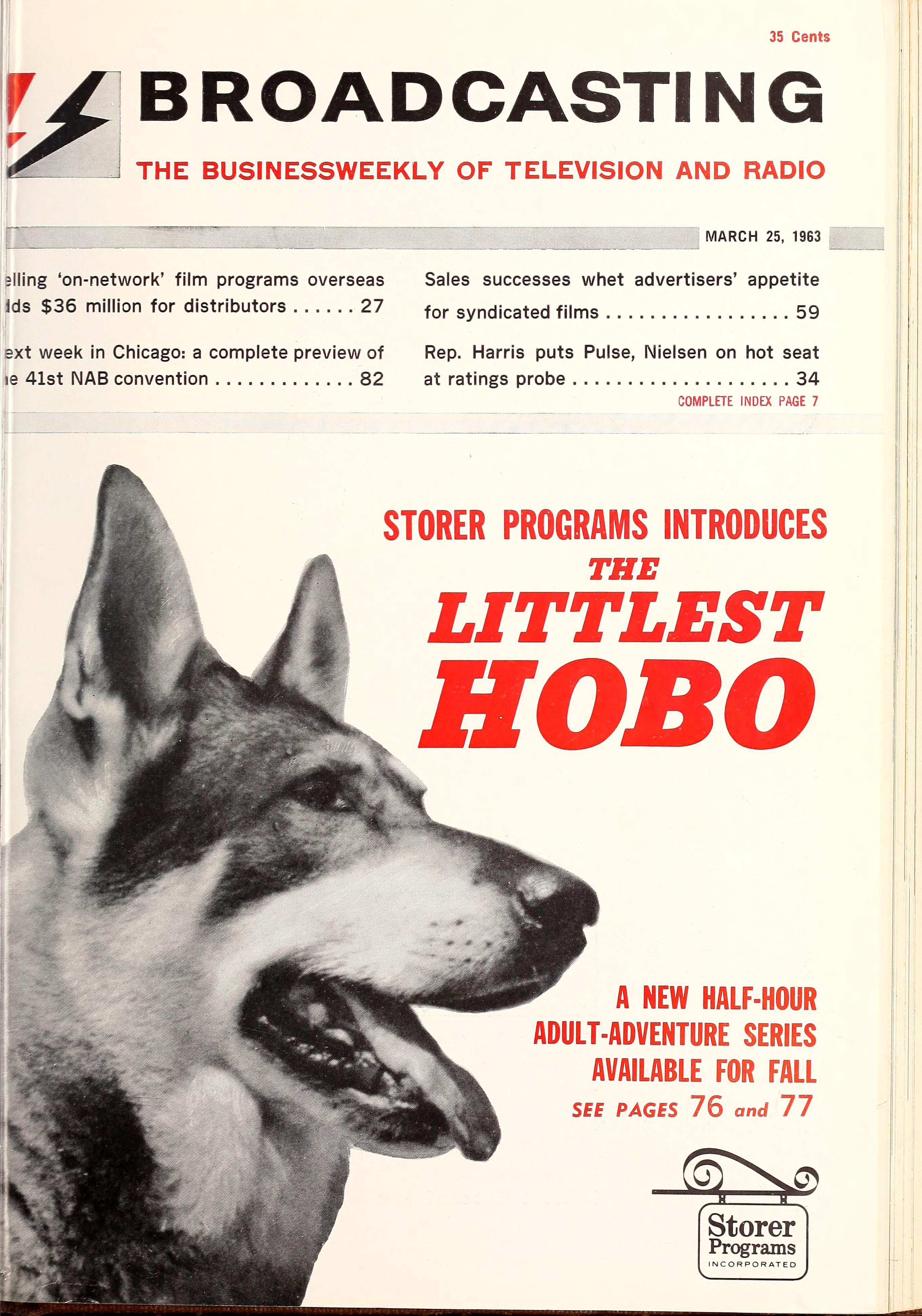
Storer Programs introduces The Littlest Hobo, Broadcasting, 25 March 1963.
Source: Broadcasting, 25 March 1963, via Media History Digital Library / Lantern.1962–65
Newspaper reports show Chuck and his dogs filming a new television version in Canada by November 1962. The series ran from 1963 to 1965 and established the familiar pattern: Hobo arrived, helped people through a crisis and travelled on.
The dog on screen did not always have to be the same physical dog. Contemporary accounts name London, Thorn, Toro and Litlon or Little London. In April 1964, the Calgary Herald reported that all four dogs in Chuck’s current group had appeared in the series as London. A second Calgary report described the four as interchangeable during filming.
That does not tell us which dog performed a particular scene. It does tell us how the illusion worked. Chuck could choose a dog for a specialist action or a particular temperament, while the markings, direction and screen name held the character together.
The London named in this publicity was not always the original dog. Contemporary reports distinguish a younger London from London Senior, so we cannot reliably put a name to every dog in every scene.
Explore the first television seriesUK television · 1964
An ABC Television publicity print said The Littlest Hobo was to begin on ABC Television on 5 January 1964. A surviving ABC schedule shows the series airing at 5.35 pm on 12 January. Together, these appear to mark the beginning of the UK television run.
The print calls the pictured dog London, although it does not tell us which individual dog he was. Its reverse also carries a “TV TIMES - LONDON - 8 MAY 1964” stamp.
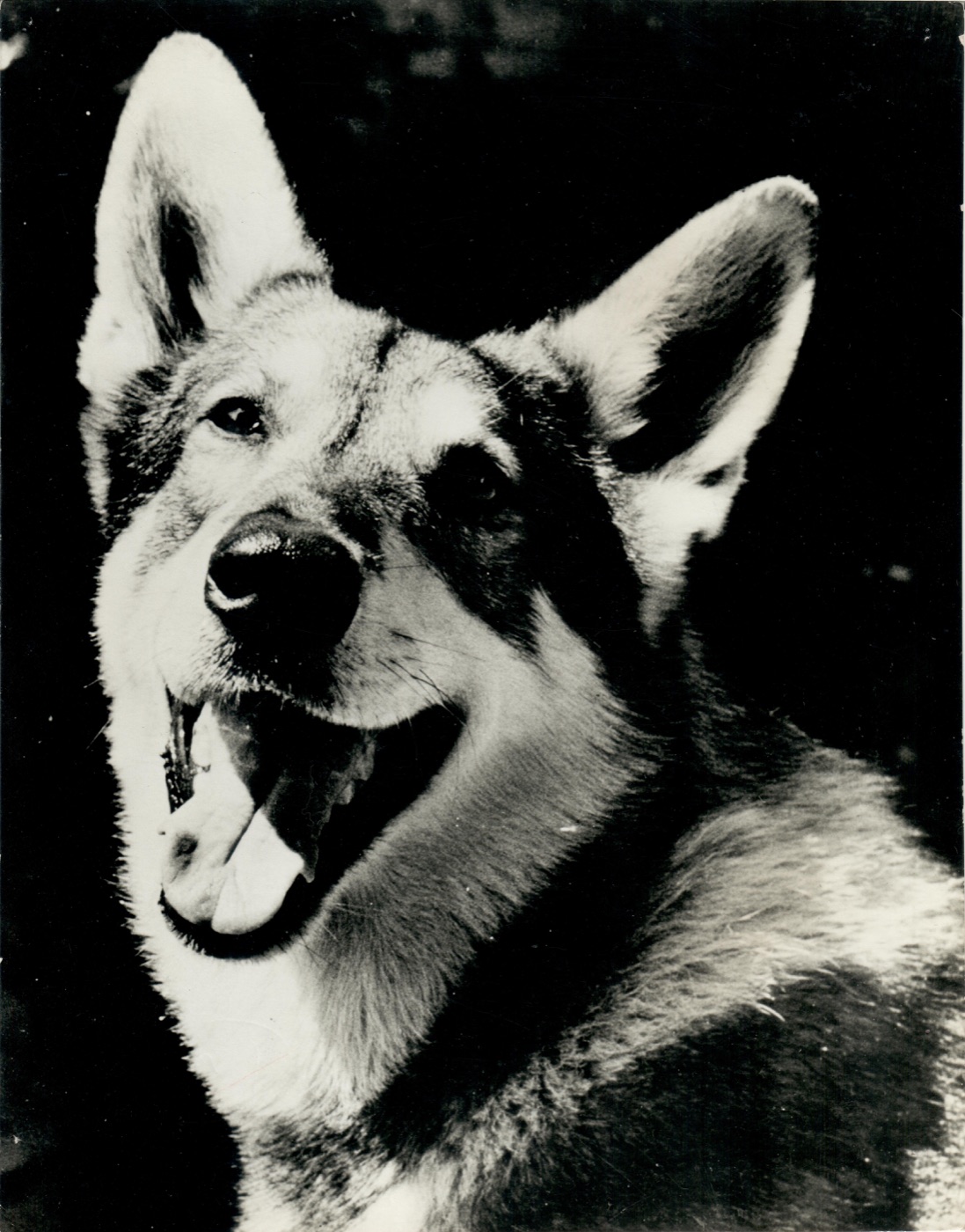
London, in an ABC Television publicity photograph for The Littlest Hobo.
Photograph: ABC Television. Courtesy of an original publicity print; ABC credited as required on the reverse.View reverse of publicity printBeyond the Hobo role
Film work, tours and television appearances all fed the public story of Chuck’s dogs.
In the 1961 feature Just Between Us, a dog was billed as London while Thorn and Toro handled named specialist actions. Early Lance made a parachute jump during the film’s publicity campaign. Later, Chuck and dogs presented as London, Toro and Hobo were connected with the 1969 Romanian-Canadian feature Silent Friends. The exact London in that production is still unknown.
Explore the other filmsTelevision let audiences see Chuck explain the dogs’ work himself. Contemporary schedules, reports, episode records and surviving footage trace appearances beyond the Hobo series.
See the television appearancesChuck and his dogs became recurring guests on talk, variety and animal programmes. The surviving evidence differs: a newspaper schedule records a planned appearance, while a report, an episode record or footage can tell us more.
These public dog names do not, by themselves, establish which individual dog appeared.
1979–85
The revival is sometimes described as The New Littlest Hobo to distinguish it from the earlier series. On screen, the familiar travelling dog returned under the title The Littlest Hobo.
Production began in Ontario in late 1979. Producer Simon Christopher Dew later recalled licensing the rights and bringing Chuck back to manage the dog action. The series eventually ran for six seasons and 114 episodes.
Chuck retained control of what the dogs were asked to do and how the action was achieved. The team could include look-alike dogs and specialists. The finished programme still asked viewers to believe in one independent traveller, but behind that performance stood careful preparation and more than one canine performer.
A later account says a dog intended for the 1979 production died on the first day. No production record has yet identified that dog. The story therefore cannot safely be attached to London, Toro, Bo or any other named member of the later team.
International recognition. In its December 1981–January 1982 issue, Cinema Canada reported that The Littlest Hobo received a Gold Medal for best television action/adventure series at the 24th International Film and Television Festival of New York. The magazine said this was the programme’s second consecutive year winning the award; the earlier win’s date and details remain unverified.
A clear moment in 1981
A Toronto Star photograph and caption from 5 June 1981 identify London as the dog then used in most scenes, with Bo, Toro, Lance and Thorn alongside him as look-alike stand-ins. Whether “London” was that dog’s formal name or the public working name used for Hobo is not yet clear.
This photograph is hosted by Getty Images. Loading it connects to Getty, which may collect usage data. Getty’s privacy policy.
The dog pictured and publicly identified as London.
Named as one of the look-alike dogs in the working team.
Named in the team; director Allan Eastman later remembered a Toro performing doorbell action.
Named as one of the look-alike dogs available for the production.
Named as part of the same 1981 group.
The version most often repeated among fans is that Toro was the principal Hobo during the first season, with Bo taking over as the main performer from the second season onwards. That may broadly describe the succession, but no complete season-by-season production record has been found, and different dogs may have taken the lead in different episodes or at different points in the production.
Director Allan Eastman remembered seeing Toro, whom he called “one of the lead dogs”, working before he began directing the series. Actor Jim Henshaw later remembered performing a long scene with London, whom he described as “a lead dog”. Their recollections need not conflict: they concern different moments in the production and suggest that more than one dog could take substantial lead work.
Still being pieced together
A dog could follow another in a screen role without being his offspring.
Help uncover the story
Production photographs, call sheets, publicity, television recordings and personal memories may help identify a dog or place an appearance. You do not need an exact date. A programme, town, approximate year or simple recollection can all add something useful.
Sources
These are the main records behind this account.