
On this page
London takes the floor
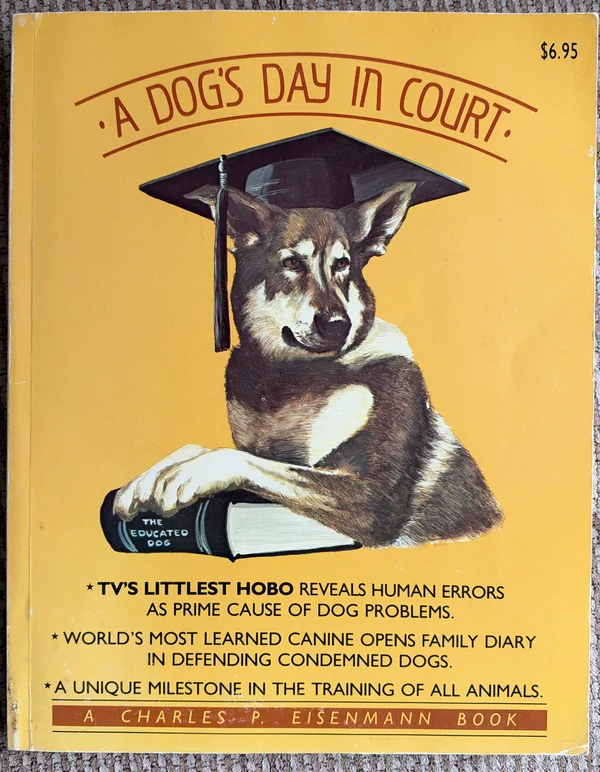
The cover gives a fair warning of what is to come: a German Shepherd wears a mortarboard and rests his paws on a book called The Educated Dog. Inside, London has plenty to say about the education of people as well as dogs.
Chuck explained that the book drew almost entirely on events from the dogs’ lives, while its manner of presentation was fictional. The courtroom gives him room to turn those experiences into stories, arguments and conversations. London can cross examine a witness, challenge a judge or tell the reader what a dog is supposed to be thinking.
Those court cases and conversations belong to the fiction. The book also contains Chuck’s recollections, photographs, captions and reproduced newspaper pieces, which offer different glimpses of his life and work.
Before the courtroom
Chuck begins with his ideas about observation and communication, including an account of demonstrating the dogs at the University of British Columbia. He then gives London the narrative voice, and the book becomes much more personal.
One of its most enjoyable stories concerns the end of a radio interview. In London’s telling, the youngest dog watches the studio’s red light, hoping to be first through the door when it goes out. The older dogs appear to be asleep, but they have already begun edging towards the exit, an inch at a time, with occasional looks to see whether Chuck is watching. By the time the interview finishes, they have a considerable head start.
Chuck uses the episode to talk about observation and experience. It also gives us a wonderfully ordinary interruption to the dogs’ public performances: however impressive the interview may have been, there is still the question of who gets out of the studio first.
The Fort Dodge recollection includes a much more anxious moment, when an older dog called London becomes ill. Chuck carries him and makes a bed from his coat while the other dogs continue the appearance. Told through the dog narrator, the passage recalls the strain of trying to care for a companion while a public engagement is still under way.
The following pages remember dogs who had died and others who had moved to new homes. Thorn, Toro and Lance appear in the account of losses, while Venus and Raura feature in recollections of visits after a change of home. These passages show how much the household had changed by the time Chuck wrote the book.
The names do need some care. Chuck used familiar names across generations, and this book does not always make their ages and relationships easy to follow. Its narrator should not simply be identified with the original London who appeared in the 1958 film.
Six dogs with a case to make
London’s court brings together Minnie, Heime, Gypsy, Byron, Zelda and Mikey, dogs whose futures are in doubt. Their stories let Chuck explore problems ranging from loneliness and jumping up to biting and fighting. As London questions the people around them, the conversation keeps returning to what those people have encouraged, overlooked or misunderstood.
Minnie and the family who grew away from her
Minnie, a Dachshund, began as a much loved puppy for a girl called Candy. As Candy grows older, Minnie spends more of her time outside, with less attention from the family. Sparrows become companions in the yard, and a neighbour offers the care she is missing at home.
Her supposed offences include roaming, tipping bins and chasing cats, but London wants the court to look at the life behind that list. Minnie’s story concerns the responsibility that remains when the excitement of bringing home a puppy has worn off. Even the question of finding her another home is treated carefully: feeling sorry for a dog is not, in London’s argument, the same as being ready to look after her.
Heime and an unfortunate greeting
Heime arrives with obedience qualifications and an accusation of biting a young woman in a film studio car park. His case turns on a habit his owners have encouraged, taking a person’s wrist in his mouth during play or to attract attention.
London’s explanation is that a familiar gesture has been misunderstood in a different situation. The fictional hearing becomes a discussion of what a dog may have learnt from people, and how little a list of obedience achievements tells the court about this particular encounter. Chuck gives considerable space to the difference between an action and the intention people attach to it.
Gypsy and the dogs in the painting
Gypsy, an Elkhound, seems unusually interested in the judge. London explains that her attention is really on a picture of dogs playing cards behind him, and on the puzzling business of painted dogs that cannot be investigated in the usual way.
Her own trouble is jumping up. The family welcomed it when she was a puppy, then became unhappy when a larger dog continued the greeting. A favourite red rubber toy called Cookie becomes part of London’s proposed alternative. The episode lets Chuck explore timing, habit and the messages owners give without necessarily noticing.
Byron and another fresh start
Byron, a Retriever, has passed through four homes. Each fresh start has brought people with their own expectations, while his difficulties with house training have followed him.
London asks the owners about the first days in their homes, feeding, opportunities to go outside and what happened after an accident. The repeated failures become a story about inconsistent routines and punishment for something nobody has adequately explained. Byron’s case gives Chuck room to discuss the patient, everyday groundwork that receives much less attention than a spectacular public demonstration.
Zelda and a familiar sound
When the prosecutor asks Zelda, a Doberman, how she pleads, she responds to a sound associated with begging: she has been taught to react to “please”. It is a small courtroom joke with a serious purpose, since the same sound means quite different things to the people and the dog.
Her case goes on to consider grabbing food, a damaged wrist and the importance of noticing a dog’s physical condition. Through Zelda, Chuck brings the discussion back to ordinary care and the danger of deciding what an animal meant before asking what happened.
Mikey and the family around him
Mikey, a Pit Bull, enters wearing a muzzle and with a history of fighting. His story takes the court beyond a single incident, into the routines of a family and a neighbourhood that has changed around him.
One revealing comparison concerns two sons and a bone. One takes it as part of a game, with the expectation that it will be returned. The other takes it to see whether he can. London uses the different encounters to argue that the people, their intentions and the dog’s previous experiences all matter.
Mikey’s case opens into the book’s longest discussion of living with dogs. Its demonstrations and eventual outcome remain part of the imagined hearing, not a record of a tested solution for every dog with similar difficulties.
Stories from a working life
The courtroom regularly makes room for Chuck’s own dogs. In his account of preparing Bo for a scene that required barking, familiar attempts to prompt a sound had failed. A raccoon’s tail catches Bo’s attention, and Chuck ends up on all fours, moving it into view and watching for the small sound he can encourage.
The scene is memorable partly because of the human effort involved. Chuck describes watching the dog, changing his approach and finding the moment to attach a word and praise to an action. The account also appears in a passage attributed to an earlier magazine article, although that original publication has not yet been identified.
Elsewhere in the story, a twenty dollar note blows away at a drive in restaurant. Lance retrieves it, Toro takes hold as well, and the note tears between them. Chuck repairs it with sticky tape. London explains the response as a change in Chuck’s own attitude: both dogs had tried to help with an object made for human fingers, so blaming them would be unfair.
These episodes make the book feel close to the daily work of travelling, performing and living together, even when London’s commentary supplies the humour and explanation.
What Chuck wanted people to notice
For all the courtroom argument, many of Chuck’s examples begin with something small: a face, a tone of voice, a familiar object or a change in where it has been placed. He is interested in how much a dog notices, and in how easily an owner can mistake a response to a familiar cue for understanding a request.
He describes early groundwork as conditioning, preparing the way for what he regards as education. Later challenges involve changing the circumstances, moving an object or presenting an obstacle, so that a familiar response will no longer be enough. His explanations include physical handling and correction as well as conversation, observation and praise.
Giving London a voice also allows Chuck to look back at himself. The dog can question human impatience, including his owner’s, and explain why a request that seems obvious to a person may be confusing from the other end of the lead.
By the closing pages, the court is discussing better preparation for ownership, public spaces for dogs and responsibility for their care. Its recommendations are proposals within the story. They show how far Chuck’s interests extend beyond getting a dog to perform a task, into the kind of life people make possible for it.
Readers interested in how these ideas developed can continue with Stop! Sit! and Think and the Training pages. For the earlier story of Chuck and the original London, David Malcolmson’s London: The Dog Who Made the Team offers a different kind of personal narrative.
Sources used
- A Dog’s Day in Court Charles P. Eisenmann, 1983. Covers, introductory material and printed pp.1 to 193.
The personal opening and Fort Dodge recollection appear on pp.1 to 36; the six cases run from p.63 through the extended discussion ending on p.189; the closing recommendations occupy the final pages.
Specific passages discussed here include the radio studio episode, pp.22 to 25; the changes among the dogs, pp.29 to 35; Bo’s bark, pp.98 to 99; the torn banknote, pp.158 to 159; and the distinction between groundwork and later challenges, p.128 and pp.161 to 165.