
Hear Chuck ask Hobo for the paper (YouTube, 3:42).
Taking the explanation home
For people who had seen Chuck on television, a record offered room for a fuller explanation. A short demonstration might show a dog choosing an object or responding to an unusual request. Here, Chuck could explain what he thought lay behind those responses, and what he wanted ordinary owners to learn from them.
He begins by challenging much of the advice his listeners might already have encountered. In his account, too many books concentrated on preparing dogs for shows or obedience competitions, leaving owners without the guidance they needed for everyday life together.
Chuck had already set out his ideas in Stop! Sit! and Think, published in 1968. The LP brings them into a more compact form: a preface, ten rules and a final summary. His examples come from the house, the street, television studios and film work, with responsibility repeatedly returning to the person making the request.
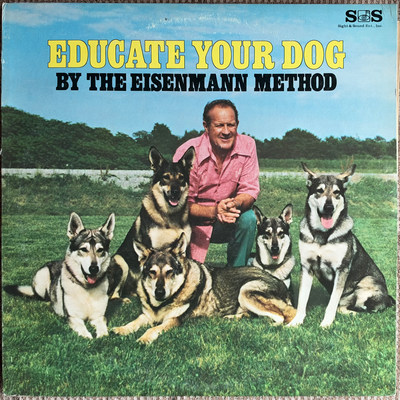
Sight & Sound Enterprises issued the LP in 1975, with Jerry Johnson credited as producer and Bill Ezell as audio engineer.
The cover places Chuck among five German Shepherds on the grass. On the reverse, a photograph shows him at a microphone with two dogs nearby. Together, the pictures introduce the family setting behind his explanation: he presents his ideas as something developed through living with dogs, not simply working with them for an occasional performance.
What the dog has already noticed
Before asking owners to teach anything, Chuck asks them to watch. Their dogs, he says, are already studying them: a particular pair of shoes, a coat or a hat might signal an outing, and whether the dog is likely to be included.
His first rule turns that attention around. What has caught the dog's interest? Where is he looking, and what is he about to do?
Chuck illustrates this with a young dog investigating bear rugs and the tape around an electrical cord. In his recollection, he catches the interest before it becomes damage, calls London away and offers something else to examine. He wants the owner to notice the beginning of the action, rather than discover its consequences afterwards.
That same concern runs through his discussion of praise and correction. A dog returning after wandering away might meet an angry owner, but Chuck asks what the dog would associate that anger with. The owner may be thinking about the disappearance while the dog is arriving home.
When he tells listeners to be positive in judging a dog's actions, he means being sure of the reason, rather than guessing. His examples include a wagging tail, a barking dog and a greeting that a person intends kindly but a dog may experience differently. Again and again, he asks people to reconsider what they think they have seen.
Five sounds, and then more to say
Chuck's five fundamental sounds are “stand up”, “come here”, “stay there”, “pick it up” and “hold it”. He explains that a beginner dog first encounters each phrase as a sound connected with an action. That is training, an essential beginning in his account, but not the whole of education.
His fullest example starts with a rubber duck and other objects. First comes picking something up, then attaching a name to it, and eventually asking which object is the duck. What interests Chuck is the gradual change from a familiar action towards recognising and choosing among things.
He also likes to begin with something a dog already does. A stretch on getting up becomes his example of how the word “bow” could be attached to a movement. Later in the record, however, he mentions a dog he says has never stretched. He does not expect to succeed in getting that dog to bow. Even within his own explanation, the individual dog's physical habits matter.
For movements a dog had not yet learned, Chuck described a different approach. He would repeat a request while the dog tried various actions, praising him immediately when he made the movement Chuck was looking for. He acknowledged that the repetition could confuse the dog, but presented it as a way of teaching something new, not as punishment. He also cautioned against continuing the exercise until the dog became bored.
Chuck wants language to grow beyond a fixed command. A familiar request can be put in different words, with the dog listening for something it recognises. He explicitly says that he does not expect a dog to know every word in a sentence. His interest is in how familiar words might help it respond when the wording changes, a process he interprets as thinking.
Hearing Chuck explain the lessons in his own voice adds something special. The Educating the dogs section follows these ideas through his books and demonstrations.
When the request is the problem
A dog might understand what is wanted and still be unable to do it comfortably. Chuck devotes a whole track to that possibility, asking listeners to consider height, build, balance, footing and the objects they have put in front of the dog.
His story about a filing cabinet makes the point particularly well. Lance opened a drawer with his teeth, while the shorter Hobo used a paw. Asking Lance to copy Hobo created a difficulty that had not existed when he chose his own way of doing it. Chuck says the experience reminded him to get down to the dog's level before deciding what should be possible.
Another example comes from The Mike Douglas Show, where, in Chuck's recollection, an awkwardly placed object prevented Hobo from completing a request. Both stories are explored in On the road with Chuck and the dogs. On the LP, their purpose is clear: before blaming the dog, look again at what the person has asked him to do.
Chuck extends that thought to the surroundings. An unstable object, a slippery floor, an unpleasant smell or an uncomfortable surface could all change the task. The brief warning to Hobo during the recording gives that concern a place in the session itself.
Praise, punishment and the owner's part
The ten rules range beyond language and demonstrations. Chuck discusses control without constant dependence on a lead, the timing of praise, his explanation of sudden bites and, finally, common sense. His central expectation is that an owner should observe, think and take responsibility, rather than simply demand a response.
Praise, in his account, can be a word, a gesture, an expression or even silence. He wants it connected closely with what the dog is doing, and eventually wants the accomplishment itself to become rewarding. Food is something he recommends when other means have failed, rather than something wholly excluded from his approach.
Chuck strongly opposed hitting dogs, shouting at them or using threatening gestures, believing these could create fear rather than understanding. He argued that a properly educated dog should rarely need punishment, saying he had punished only one dog in the preceding eleven years. When he believed correction was necessary, he described holding the dog still by the loose skin below its ears and talking to him steadily for at least fifteen minutes. He specifically said the dog should not be shaken, describing his intention as physical restraint rather than physical harm. Above all, he stressed that the owner must be certain the dog understood why he was being corrected.
His explanations of fear, reflexes and canine reasoning are equally part of his own thinking. Listening to the whole record lets us follow how he connects them with the familiar problems he thinks owners have overlooked.
In the summary, Chuck returns to the owner. Learning the rules is not enough, he says, unless the person is prepared to learn too. Then he urges his audience to listen again, repeating the invitation several times, much as he has described repeating a new phrase to a dog.
Listen to the record
My Weird Record Collection has uploaded a twelve-part transfer to YouTube. The links below follow the sleeve's original order, with five tracks on Side I and seven on Side II. Tracks two to eleven contain Chuck's ten rules.
The links take you to the collector's individual uploads on YouTube. Open the complete playlist, or choose a track below.
Side I
Preface
Chuck introduces the purpose of the record, his distinction between training and education, and the five sounds and ten rules.
Learn to observe your dog as he observes you. Never overlook a single glance or movement
Shoes, clothes and small movements introduce his discussion of attention, followed by the young dog's interest in bear rugs and an electrical cord.
Always be positive when judging the reasons for your dog's actions
Ten true or false examples challenge assumptions about dogs. They illustrate this rule, rather than adding another ten rules to the method.
Learn how to use mental instead of physical approaches to both training and punishing your dog
Chuck discusses fear, correction and punishment, including the prolonged restraint he recommends as an alternative to hitting.
Gain control of your dog by using the mental instead of the physical leash
A chewed lead and encounters with other dogs illustrate his idea of control. Hobo also comes too close to the microphone.
Side II
Never ask your dog to perform a task which he mentally understands but physically cannot accomplish
Stories about Hobo, Lance and filming explain why Chuck asks owners to consider a dog's physical capabilities before judging a response.
Learn to compliment and reward properly
Timing, expression and encouragement lead into his example of attaching a word to a dog's natural stretch.
Do not use single word commands. They limit a dog's potential
Chuck explains why he changes the wording of requests and what he believes a dog can learn from familiar words in different phrases.
Learn the danger of a dog's physical and mental reflexes
His explanation of apparently sudden reactions includes an interruption at about 3:42, when he asks Hobo for the dropped paper.
Use the five fundamental sounds in conjunction with the things your dog has been trained to do
He brings the sounds together through examples involving standing up, a screen limp and choosing named objects.
Make common sense your final guide
Chuck returns to physical differences, overlooked surroundings and the owner's responsibility to think before blaming the dog.
Summary
The educated dog and the owner's willingness to learn bring the record to a close, followed by Chuck's repeated invitation to listen again.