
The magazine pictured Thorn, Toro, London and Litlon, explaining that they could respond to London as a performing name as well as to their own names. Its editors watched them work with unfamiliar objects in a room where they had not performed before. Sometimes a dog paused before responding. If an object was beyond reach, the report described the dog indicating it and turning back towards Chuck. The equipment had changed, but the demonstration went ahead.
For anyone who knew London only as the wandering hero of The Littlest Hobo, meeting Chuck and his dogs offered a different sort of entertainment. Here were several dogs together, with a man who talked to them at length, asked questions and invited other people to join in. He wanted audiences to see what he believed dogs could learn when people expected more of them.
Chuck's conversation ranged well beyond their screen appearances. He questioned why people left dogs in kennels when they went on holiday, rather than taking them along with the family. He described owning a dog as a responsibility, not simply acquiring an animal that would obey a few instructions.
The original television series finished in the mid 1960s, and the revival did not arrive until 1979. Between them, Chuck and his changing household of dogs kept appearing in shops, shopping centres, newspaper offices and television studios. He also wrote Stop! Sit! and Think, recorded his ideas on a spoken LP and continued working in films.
Visitors to the newsroom
When Vancouver columnist Les Wedman met the dogs in 1969, it followed an earlier disagreement about their abilities. A mutual acquaintance, Gordon Minchin, had promised to bring Chuck along for a demonstration.
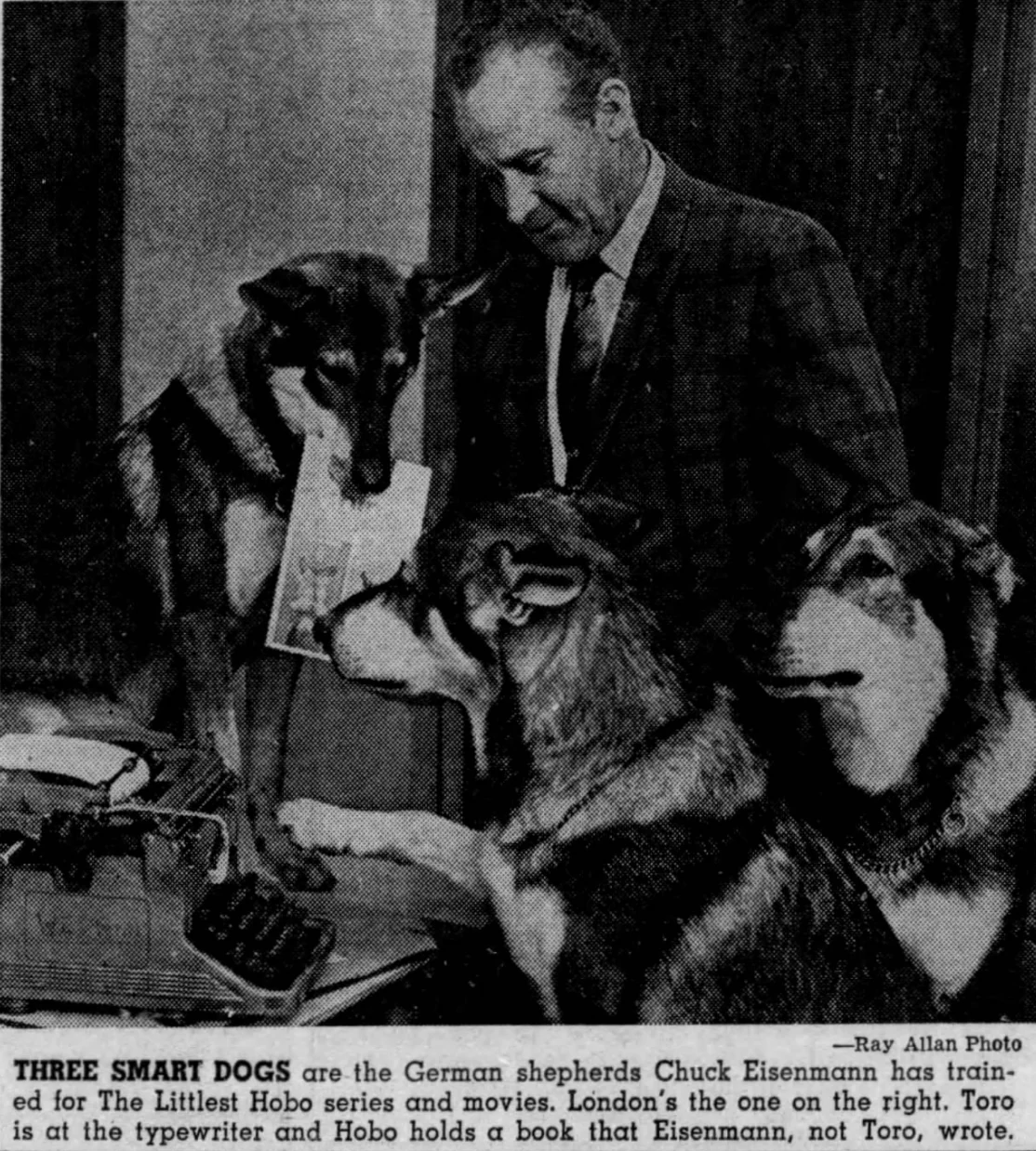
Wedman described Toro identifying objects, responding to spelled requests and turning on a television. The accompanying photograph brought the visit down to the scale of a newspaper office: Toro at a typewriter, Hobo holding Chuck's book, and London alongside them. Wedman's colleague Mac Reynolds supplied the obvious newsroom joke, asking how the dogs managed with clichés.
The visit also gave Chuck a chance to talk about the programme. In Wedman's account, he felt that relatively few of its scripts had shown the dogs' capabilities as fully as he wished. His demonstrations let him try something different, with an audience watching the requests and responses as they happened.
A hotel room in Calgary
Linda Curtis met Chuck and four dogs in a Calgary hotel suite in September 1971. They were travelling on a tour sponsored by Quaker Oats, with appearances advertised at several of the city's shopping centres.
Her interview captures the dogs away from a television adventure. Hobo was dozing in a corner when Chuck asked him to indicate something romantic that was not alive. Curtis reported that he approached a pot of artificial roses on the desk.
Another request was less straightforward. Chuck asked for a piece of paper carrying advertising. A restaurant menu was on the door, but a settee left little room to reach it. Hobo approached the door and took hold of the knob. Chuck moved the furniture and tried again. This time, Curtis wrote, Hobo stood on his hind legs and indicated the menu with his nose.
The handbag request needed clarifying too. There was a handbag on the floor and a larger bag on a chair. When Hobo went to the larger one, Chuck made his request more specific, asking for the bag with two zips. Curtis reported that he then brought her purse.
Chuck used these moments to explain why he thought people needed to consider what they had actually asked, and whether the dog could comfortably do it. He was willing to move the furniture or make his request more precise.
When Curtis prepared to leave, the dogs were resting around the room. She described their change of mood when Chuck casually announced that it was time to go outside, followed by the sight of them romping on the grass.
Betty White wished they had more time
Surviving footage from two of Chuck's appearances on Betty White's The Pet Set brings us especially close to him at work in 1971. In one, Peter Lawford joins the conversation. In the other, Dennis Weaver and his son are among Betty's guests.
Before the first demonstration, Betty tells viewers that the dogs have not seen the day's arrangement of props. She knows that what follows might look rehearsed, and asks the audience to take her word for it. Chuck introduces London, Hobo and the young females Venus and Raura, whose name is also written Roura in accounts of the group.
The studio gives them plenty to look at. London needs redirecting from a leopard elsewhere on the set. Chuck asks about flowers and colours, spells a person's name and moves objects as he explains what he is doing. Betty joins in when Chuck invites Raura to visit her. A moment later, he calls Hobo forward.
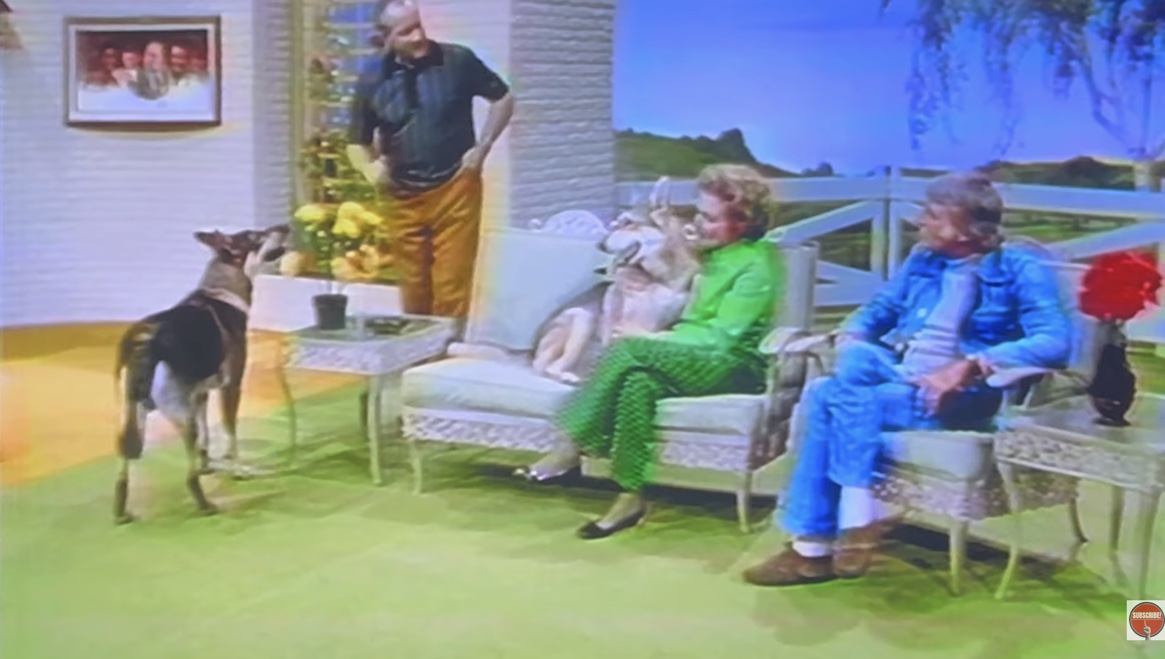
The second appearance makes room for a younger dog. Chuck calls Venus forward and repeatedly asks her to pick up objects, explaining that he attaches a name to an item after she has taken it. Viewers see the requests being repeated and the dog being guided through the exercise, as well as the older dogs' more elaborate demonstrations.
Later, Dennis asks London what he is missing. With further prompting from Chuck, London brings him a hat.
Chuck presents these exercises as evidence for his ideas about language and reasoning. His explanations help us follow what he is trying to show, while the pauses and repeated requests let us see how much he is guiding the action. We also hear his manner with the dogs: the repeated names, the requests to hurry, the polite phrases and the readiness to try another way of asking.
Betty's enthusiasm is part of their appeal. As time runs short, she asks Chuck to come back. During the later appearance, she wishes they could carry on and jokes about switching off the cameras. On both programmes she tells viewers about Stop! Sit! and Think.
Chuck was also a guest on Johnny Carson's Tonight Show, The Mike Douglas Show and The Merv Griffin Show. You can explore more of those visits in Chuck and the dogs on television.
One Mike Douglas story survives in Chuck's own voice on his LP. He recalled Mike giving Hobo an object to put in a wastepaper basket, but placing it too far into the dog's mouth. Chuck described Hobo dropping it on a chair, then putting a paw on the basket. When offered another object, he said, Hobo completed the task.
Chuck told the story to explain why a dog might fail to do something it had been asked. In his account, the difficulty was physical, not a failure to understand.
The life behind the demonstrations
In Stop! Sit! and Think, published in 1968, Chuck writes about the demands that public work placed on the dogs. He describes long filming days, disagreements about feeding times and the need to let the dogs rest. In his view, lying down did not necessarily mean that a dog had stopped attending to what was happening around it.
He also recalls a Winnipeg motel visit during which children began shouting into the dogs' ears and poking at their eyes. He intervened with their parents. The account is undated, but it makes clear that he expected people to treat the dogs considerately, however familiar their television appearances might have made them seem.
Ronald Keith's 1972 Weekend Magazine profile offers a glimpse of a different setting, Chuck's North Vancouver home. Keith describes guests spending a Sunday afternoon in the living room, with London present while they talked. Chuck later asked the dog to identify people by descriptions drawn from the conversation, including a baby's age and family connections.
Keith presented the responses enthusiastically, as demonstrations of London's understanding. The scene also gives us an unusual picture of Chuck entertaining visitors: conversation in the living room could become another opportunity to show what he thought a dog might notice.
The household did not remain the same throughout these years. Familiar names recur in photographs and interviews, sometimes attached to younger dogs. The London on Betty White's programme should not be confused with the original dog who appeared in the 1958 film. The individual histories are explored more fully in The Dogs.
Chuck's ideas in print and on record
The book gave Chuck space to explain what could only be glimpsed in a short television appearance. He distinguished early training and conditioning from what he regarded as teaching or education, and asked owners to spend more time observing and talking to their dogs. His accounts of daily life sit alongside forceful opinions about the ways people kept and trained them.
The guide to Stop! Sit! and Think explores that mixture in more detail. It is a book about Chuck's expectations of people as much as his expectations of dogs. Teaching the dogs follows his explanation of the method across his work.
His spoken LP, Educate Your Dog by the Eisenmann Method, was issued in 1975. It brings the ideas together as five fundamental sounds and ten rules, illustrated with stories from home, television and filming. His explanation returns again and again to the owner's responsibility to observe the dog and make a request clear.
His examples could be wonderfully practical. He recalled Lance opening a filing cabinet with his teeth, while the shorter Hobo used a paw. When he asked Lance to copy Hobo, the difference in their height made the action awkward. Chuck said that the experience reminded him to look at a task from the dog's level before deciding what should be possible.
The record was a way of taking his explanation beyond the people who could meet him on tour. The dogs were still close by: during the session, he interrupted himself to speak to Hobo beside the microphone. A collector's twelve-part transfer of the LP, uploaded by My Weird Record Collection, offers a way to hear Chuck's explanation in his own voice.
A dog at the typewriter
A photograph by David Valega preserves another public encounter in Oklahoma City in 1975. Chuck stands beside a German Shepherd with its paws at a typewriter. The Oklahoma Historical Society's caption identifies the dog as Hobo and places the demonstration at Crossroads Mall.
It is a lively reminder that, while Hobo's adventures continued to reach television viewers, Chuck and his dogs were also meeting people face to face.
By the time The Littlest Hobo returned in 1979, Chuck had spent much of the intervening period showing people his dogs outside the confines of a fictional adventure. The revival brought their screen work back to the centre of the story. The interviews, demonstrations, book and record let us follow the life that carried on between the two series.