
The next morning, Hobo was back beside the house, barking. Getting near him was another matter. Food and kind words did not bring him closer, and when Chuck tried to corner him, he leapt past his outstretched hands and escaped over another part of the fence.
Several hours later, Chuck spotted him across the road. This time he drove into a driveway, opened the station wagon's back door and quietly asked whether he wanted to get in. Hobo climbed into the back.
From an unsettled beginning, Hobo became part of Chuck's travelling family. He visited newspaper offices and shopping centres, worked on a film in Romania and even appeared on Betty White's television programme. He had adventures of his own, quite apart from the fictional Hobo on screen.
Finding his place
Chuck tells the story near the end of his 1968 book. He had chosen the youngster to join him shortly before a busy run of personal appearances, although he does not say when or where this happened. He calls Hobo a son of Toro, a relationship that later accounts would describe in different ways.
Their first meeting had not gone smoothly either. Hobo barked and growled when Chuck approached him at his previous home. A girl in the family pulled him over, and Chuck says he had to drag him to get him into the car. The later escapes were part of a difficult adjustment, not the beginning of an immediately easy partnership.
Over the following days, Chuck described a dog who chased anything that moved, dug beneath fences and headed off whenever he got the opportunity. He wrote that within thirty days Hobo had left those habits behind and acquired a considerable collection of new actions. Among them were shutting a door, untying a shoe, retrieving objects and putting them on a table. He also described Hobo settling into the conduct expected in motel lobbies and outside shops.
Chuck remembered remarkable progress over those thirty days. He gave some of the credit to the older dogs and to Hobo's own willingness to learn. The youngster was finding his place in a household as well as learning from Chuck.
A traveller with Chuck
By June 1968, a Cleveland newspaper was naming Hobo alongside Toro, London and Thorn during a visit by Chuck. The dogs travelled in an air-conditioned station wagon, and appearances at a local fair were being advertised. For Hobo, the world beyond the yard was becoming a much busier place.
A photograph published in the Vancouver Sun the following February gives us a particularly enjoyable glimpse of that public life. Chuck and three dogs had come to the newspaper office. Toro was at a typewriter, London stood on the right, and Hobo held a copy of Stop! Sit! and Think. The caption even jokes that Chuck, not Toro, was the one who had written the book.
See the 1969 Vancouver Sun photographAccess may require a Newspapers.com subscription.
Later in 1969, Romanian film magazine Cinema named Hobo among the dogs working with Chuck on the adventure film Silent Friends. London and Toro were described as the principal canine performers, with the young Hobo in a smaller role. Once again, the dogs were working as a team.
In August 1970, a Waterloo newspaper named the touring group as London, Hobo, Venus and Raura. Reports over the next few years let us follow Hobo through further public appearances. The newspaper accounts help us follow this Hobo as he grew into an experienced travelling companion.
Hobo on Betty White's set
The surviving footage from two appearances on Betty White's The Pet Set brings us closer to Hobo at work in 1971. Chuck introduces him by name, alongside London, Venus and Raura. Peter Lawford is there for one appearance, while Dennis Weaver and his son join Betty for the other.
In the first, Chuck invites Raura to visit Betty and then calls Hobo forward. He asks Hobo about a picture, flowers and a tree, repeating and changing the requests as the demonstration continues. There are pauses, further instructions and encouragement to hurry. Watching the whole exchange gives a much better sense of their work together than a description of the successful moments alone.
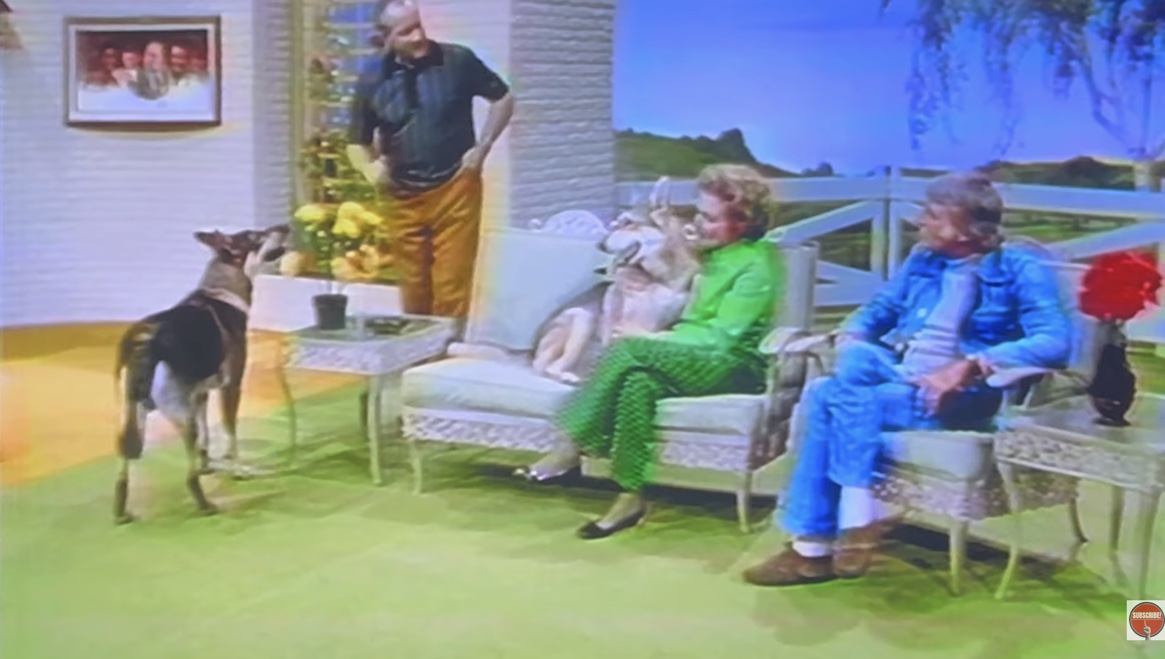
Chuck is explaining his approach as well as showing what the dogs can do. During the later appearance, he uses Hobo to move from familiar requests towards differently worded ones, with a round container and a wastepaper basket among the props. He presents the exercises as examples of teaching a dog to understand more, rather than simply repeating a fixed command. Watching the footage, we can see how carefully Chuck guides Hobo through each exercise.
Betty's enthusiasm helps make the visits such enjoyable viewing. She wants Chuck to return and wishes there were more time with the dogs. You can watch the surviving compilation, which brings together the Peter Lawford and Dennis Weaver appearances.
Hobo's place in the family
Chuck called Hobo a son of Toro in his book and described Hobo and London as brothers on The Pet Set. Other reports give different versions of their relationships. The Romanian production article makes London the father of Toro and Hobo, while a 1974 Calgary account calls London and Hobo half-brothers and describes a Toro as Hobo's son. With familiar names used by more than one dog, those accounts do not give us a settled family tree.
In 1974, a newspaper found Hobo appearing with Chuck at the Calgary Stampede, aged six.
On Educate Your Dog by the Eisenmann Method, Chuck also speaks to a dog called Hobo beside the microphone, asking him to pick up a dropped paper. The recording is undated, so it may be another Hobo. Bo, named in accounts of the later television series, was a different dog.
For a more immediate meeting with Hobo, the Pet Set appearances are a good place to linger. They let us see him among the other dogs, with Chuck talking him through a request and Betty following the exchange. The Dogs overview introduces the travelling family around him, while On the road follows more of their encounters away from the adventure series.